

U.S. Gun Policy Imposes Costs Beyond Its Borders
Gun trafficking is a global public safety crisis, and the United States is the predominant source of trafficked guns. Guns are trafficked from weak gun law states to stronger gun law states within the United States, and from the U.S. to nations with far stronger gun laws abroad. Domestically, permissive U.S. gun policies result in gun death rates that are 20 times higher than in comparable countries, but U.S. gun policy has international effects as well.
Cross-border gun trafficking from the U.S. contributes to nations in the Americas having the highest gun death rates in the world, accounting for over half of global gun deaths.1 It also enables organized crime, human trafficking, drug trafficking, and a host of other public health, human rights, and societal harms.
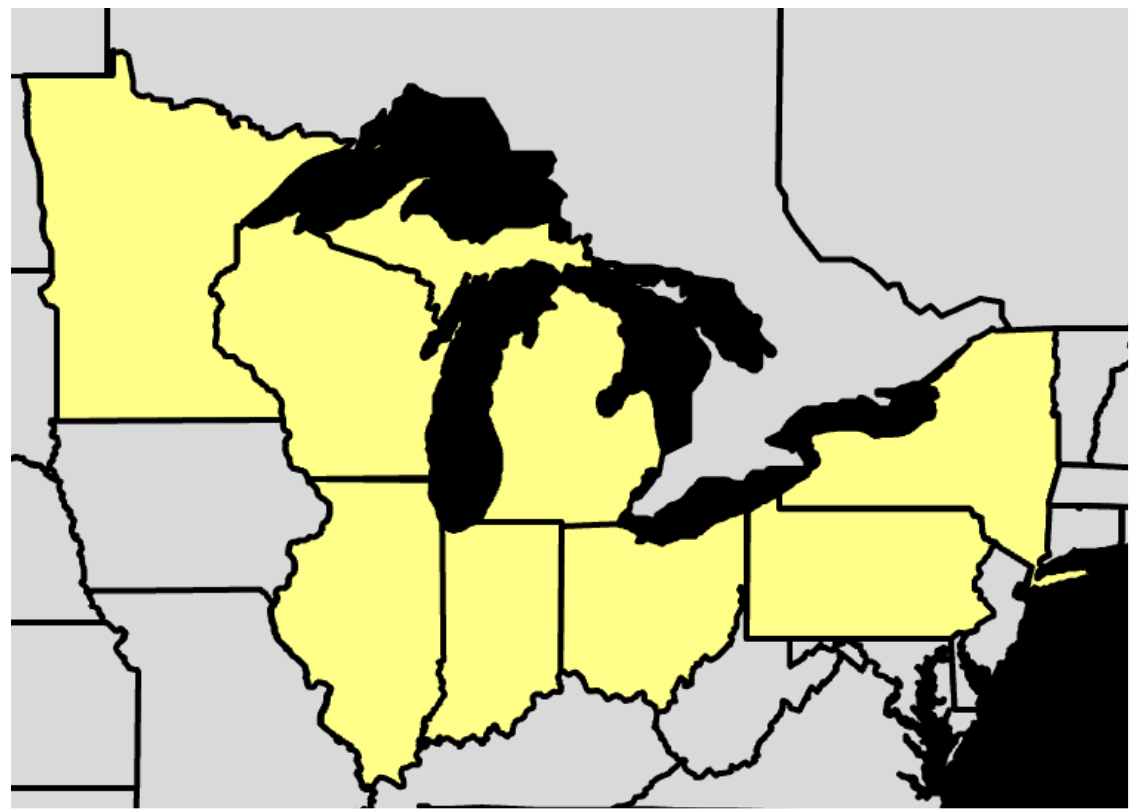
Why This Report Focuses on the Great Lakes
This report examines one major regional pipeline: the U.S. states bordering the Great Lakes. A problem as vast as international gun trafficking is difficult to comprehend. One promising way to examine it is to break it down, analyzing one region that plays an outsized role in cross-border gun trafficking in detail. This report provides an in-depth examination of cross-border gun trafficking from and through the Great Lakes region, along the U.S.’s northern border. Those states are Illinois, Indiana, Michigan, Minnesota, New York, Ohio, Pennsylvania, and Wisconsin. The U.S. Bureau of Alcohol, Tobacco, Firearms and Explosives (ATF) has reported that Ohio is the leading source state of crime guns recovered in Canada, with Michigan fifth.
Canada is the region’s central foreign crime gun destination, but the Great Lakes trafficking problem reaches farther.
Given the close relationship between Canada and the Great Lakes, their geographic proximity, and the volume of trafficking between the regions, Canada is the major foreign destination discussed in this report. However, guns are trafficked from the Great Lakes region to other countries as well, including countries in Latin America and the Caribbean, as well as regions as far as West Africa and the Middle East. The report covers the impact of U.S. guns on Canada’s gun violence problem, and the problem of cross-border trafficking to other countries.
The Association of Weak Gun Laws and Gun Trafficking
The association between weak gun laws and gun trafficking is revealed by crime gun tracing – the determination of the commercial history of guns recovered by law enforcement.2 Tracing data identifies where crime guns were sold and where they ended up in crime, which tends to show that trafficked guns are purchased in states or countries with weak gun laws, and brought to places with stronger laws. Further, highlighting the association between strong guns laws and crime gun supply, the five states that ATF found had the lowest percentages of crime guns traced to purchasers were in the top six highest ranked states for strong gun laws in Everytown’s rankings.3
This pattern makes sense: permissive, or weak, gun laws make guns more generally accessible, including to potential gun traffickers. Gun traffickers buy guns where they can obtain them, easily and efficiently, without detection. If they could buy guns closer to home, they would, as would any purchaser of any product, legal or illegal. Permissive countries and states, with willing gun dealers, are therefore susceptible to being sources of gun trafficking.
Traffickers seeking to arm criminals in Canada generally obtain their guns in the U.S. because it is hard for them to obtain guns at home, and easy for them to obtain guns here. That is largely a product of reckless gun industry practices in the U.S. – and the weak federal and state laws enabling them.
The fact that trafficked U.S. guns are the overwhelming source of Canadian crime guns suggests that the most impactful solution to Canada’s gun violence problem must come from the southern side of the border: U.S. gun dealers, distributors and manufacturers, and U.S. and state policymakers.
Gun Ownership in Canada
Canada is a stable country, with a significant hunting and gun culture, and one of the world’s highest rates of legal civilian gun ownership (5th globally, behind the U.S. in 1st, Yemen in 2nd, and Serbia and Montenegro tied 3rd).4 While Canada has low rates of violent crime compared to the rest of the Americas, it has relatively high rates of gun mortalities—2.21 per 100,000—when compared to comparable countries such as Australia and the U.K., with firearm mortality rates of .76 per 100,000 and .11 per 100,000 respectively, shows the staggering discrepancy (although far less than the U.S.).5
How do Canadian criminals arm themselves? They mostly obtain their weapons from traffickers who buy guns in Canada’s lax gun-selling southern neighbor: the United States. Reporting from Canadian officials for 2024, emphasizes that in urban centers of Ontario over 90% of recovered and traced crime guns originated from the U.S.6

Ohio Spotlight:
The Great Lakes’ Central Source State
ATF trace data identifies Ohio as the leading source state for traced crime guns recovered in Canada and the fourth-leading source state for traced crime guns recovered in the Caribbean. Ohio combines several likely contributing factors: a large firearms market, weak gun laws, permissive private-sale and gun-show environments, limited dealer oversight, industry-protection laws, restrictions on local regulation, and proximity to the Detroit-Windsor trafficking corridor. Those factors make Ohio a profound example of how state policy choices can turn a legal firearms market into an international crime-gun source.
A Failure to Address Ohio’s Contributing Role to Gun Trafficking
The fact that Ohio has been a major source state for gun trafficking has been known for decades – including by Ohio lawmakers.
- A 2003 report found Ohio was seventh in the U.S. and first in the Midwest in exporting crime guns to other states. 7
- A 2013 report reached similar conclusions a decade later; as Columbus, Ohio Deputy Police Chief Jeffrey Blackwell explained: “People know they can come to Ohio, get a gun and take it someplace where there are tougher restrictions. It happens at gun shows in the sticks and through underground schemes on city streets.” 8
- Eight years later ATF’s finding that Ohio was the top source state of crime guns to Canada was widely reported.9
In response, Ohio legislators have made its gun laws weaker, rather than attempting to stop the crime gun pipeline from their state.
The Great Lakes as a Source for Cross-Border Gun Trafficking
Cross-border gun trafficking is not some vague, undetectable phenomenon; it manifests in specific instances where guns are brought across the border, by the trafficker or someone else, and then used in crimes to victimize innocent people and communities.
The following case provides a window into the scope of the gun trafficking problem, and shows how guns are trafficked from licensed U.S. dealers to the criminal market in other countries.
Grin and Barrett:
A Cartel Trafficking Network in the Great Lakes
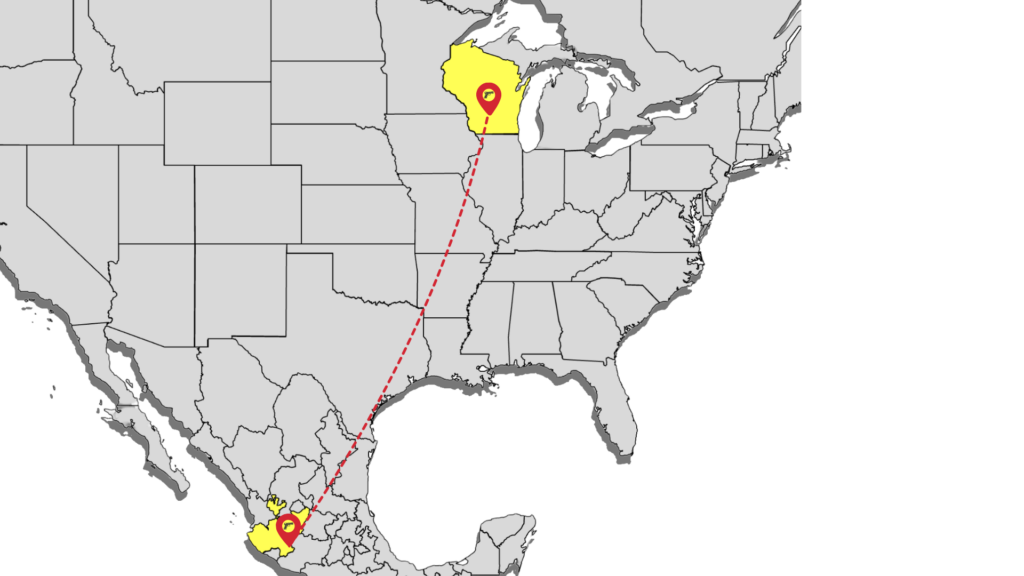
In one trafficking case, known as “Grin and Barrett” for the high caliber Barrett .50 caliber rifles that led to its discovery, a Wisconsin family built what one ATF official called “the most prolific [Jalisco New Generation Cartel] firearms trafficking network ever discovered.”10 The network, with U.S. operations centered on the Wisconsin-based cousin of a Mexican trafficker, sprawled across 13 states, and transferred over $600,000 worth of military-grade weaponry to cartel buyers in under a year.
Mexican authorities detected the trafficking ring during an investigation into a cartel hit squad responsible for the attempted assassination of a government minister. After recovering the weapons they found at the cartel safehouse, they traced one Barrett .50 caliber rifle to a firearms dealer in Wisconsin, Shooters’ Sports Center, where it had been purchased just two months before the raid – a remarkably brief time-to-crime that meant it had almost certainly been sold directly into the criminal market. Further investigation revealed that the store, which was “lucky to sell one Barrett .50 caliber in a normal year,” had sold four such guns to two brothers and their associates over the course of just six months.
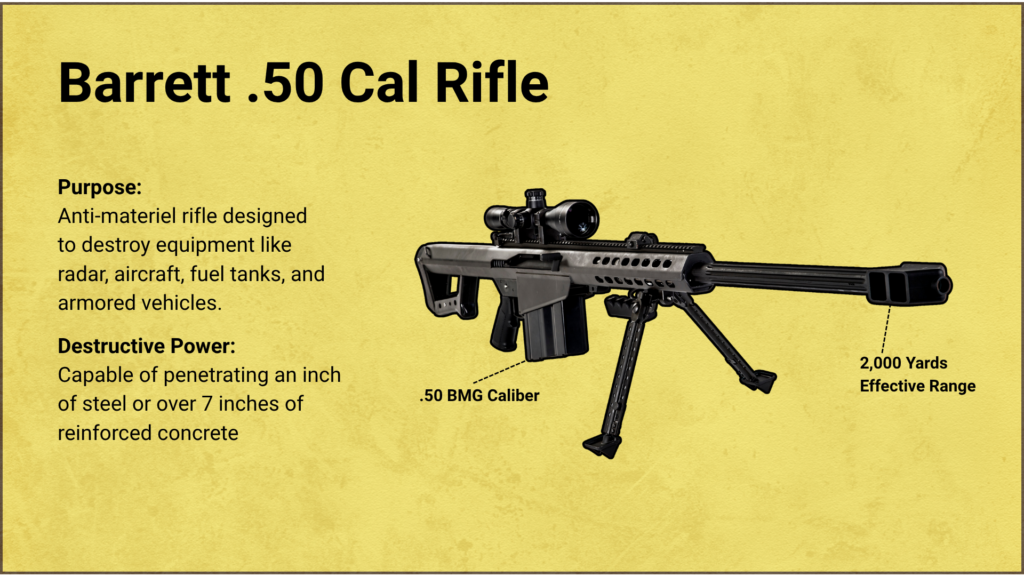
The exceptionally long range and powerful rifles, prized by cartels for their ability to deal immense damage over great distances, have become crucial in their fight against the Mexican government and one another. Mexican authorities recovered over 300 Barrett .50 caliber rifles between 2020 and 2023, and cartels have used them to shoot down Mexican military helicopters, ambush law enforcement officers, and assassinate government officials. In the U.S., they are the highest quality military-grade weaponry available on the civilian market, where they sell for $9,000. On the Mexican black market, the price rises from $30,000 to $50,000.
ATF agents stepped in after flagging the alarming number of Barrett sales at gun stores in the area, raiding the traffickers’ home four months after an ATF tail saw them with 2 military-grade assault rifles. The agents recovered 52 firearms, 3 empty Barrett cases, and 2 lavish Colt 1911 pistols covered in gold-plating and cartel insignia.
The operation, with clear trafficking signals such as multiple purchases, multiple related buyers over a short time period, and unusual military-style guns, could have been easily prevented by a gun dealer who simply asked the right questions about why the traffickers wanted the military-grade weapons or why they needed them in such high quantities. The dealers in this case chose profit instead.
Solutions
The Great Lakes gun-trafficking problem is not inevitable. It is enabled by reckless gun industry practices enabled by weak laws, uneven enforcement, inadequate dealer oversight, special protections for the gun industry, and insufficient cross-border coordination. The following reforms would reduce the flow of trafficked firearms from the Great Lakes region and from the broader U.S. market into Canada and other countries.
Federal Policy Reforms
Congress should enact laws that regulate firearm sales and the gun industry in ways that make trafficking harder to carry out and easier to detect. Federal law should restrict high-risk sales practices, including repeated and multiple sales to purchasers who exhibit trafficking indicators, require stronger oversight of licensed dealers, and close gaps that allow private sellers and reckless dealers to supply the criminal market. Specifically, this should include:
- Requiring universal background checks for all gun sales
- Requiring licensing, permits to purchase, or other individualized vetting of buyers
- Restricting or enhanced vetting of high-risk bulk and repeat sales
- Enhancing oversight and regulation of gun dealers
State Policy Reforms, With Special Attention to Ohio
Ohio and other Great Lakes states that are a source of gun trafficking should enact stronger gun-safety laws, including:
- Requiring universal background checks for all gun sales
- Requiring licensing, permits to purchase, or other individualized vetting of buyers
- Requiring state dealer licensing
- Requiring reporting of lost-and-stolen guns
- Mandating crime-gun tracing
- Restricting or enhanced vetting of high-risk bulk and repeat sales
Because Ohio is the region’s leading problem state, Ohio reforms would be the most impactful in reducing cross-border gun trafficking and should be the top priority. For Ohio specifically, the highest-priority reforms are universal background checks, permit-to-purchase or licensing requirements, state dealer licensing and inspection authority, mandatory crime-gun tracing, meaningful oversight of bulk and repeat sales, restoration of local regulatory authority, repeal of state-level gun-industry immunity provisions, and stronger accountability tools for dealers and distributors that repeatedly supply guns later recovered in crimes.
Gun Industry Accountability
Legal accountability has led to significant life-saving reforms of numerous industries whose products and practices have adversely impacted public health, including tobacco and opioids. However, special protections for the gun industry prevent full accountability for the gun industry in the U.S. Federal and state policymakers should eliminate those special protections that allow negligent gun manufacturers, distributors, and dealers to avoid accountability when their practices facilitate trafficking. This includes repealing the Protection of Lawful Commerce in Arms Act (PLCAA), that prevents holding some bad actors accountable for facilitating trafficking, and the Tiahrt Amendment, that prevents significant disclosure of industry sources of crime guns and trafficking.
States should adopt firearms accountability laws and codes of conduct that establish reasonable business practices for the gun industry, including refusing to supply dealers with repeated crime-gun traces and requiring safe sales practices designed to detect straw purchasing and trafficking.
Enforcement and Dealer Oversight
ATF and state enforcement agencies should focus resources on the small share of dealers that supply a disproportionate number of crime guns. Enforcement should prioritize dealers with repeated trafficking indicators, short time-to-crime traces, multiple sales to the same purchasers, and sales patterns associated with straw purchasing. Stronger inspection, investigation, license-revocation, and referral practices would help force problem dealers to reform or stop supplying the crime-gun market.
Civil Litigation and International Accountability
Civil litigation can reduce trafficking by incentivizing or forcing problem dealers, distributors, and manufacturers to implement best practices. Lawsuits in the United States can use remaining pathways under PLCAA, including statutory predicate claims, while litigation outside the United States may provide broader accountability because foreign courts are not constrained by PLCAA. These cases can encourage safer sales, distribution, and oversight practices that reduce the supply of crime guns.
Cross-Border Cooperation
The United States and Canada should strengthen cross-border tracing, intelligence sharing, outbound inspection, joint investigations, and dedicated enforcement capacity focused on firearms trafficking into Canada. The United States should recognize its responsibility to prevent guns from being trafficked over its borders
Read the Full Report:
Endnotes
- World Population Review, “Gun Deaths by Country 2026,” https://worldpopulationreview.com/country-rankings/gun-deaths-by-country
- Everytown for Gun Safety, “Five Things to Know About Crime Guns, Gun Trafficking, and Background Checks,” October 10, 2022, https://everytownresearch.org/report/five-things-to-know-about-crime-guns/#five-things-you-need-to-know
- U.S. Bureau of Alcohol, Tobacco, Firearms, and Explosives, “PART III: Crime Guns Recovered and Traced Within the United States and Its Territories,” National Firearms Commerce and Trafficking Assessment, March 27, 2024, https://www.atf.gov/media/15426/download; Everytown for Gun Safety, Gun Law Rankings 2026, https://everytownresearch.org/rankings/
- Small Arms Survey, “Civilian Firearms Holding, 2017”, 2018,
https://www.smallarmssurvey.org/sites/default/files/resources/SAS-BP-Civilian-held-firearms-annexe.pdf - Evan D. Gumas, et al., “Comparing Deaths from Gun Violence in the U.S. with Other Countries,” The Commonwealth Fund, October 30, 2024, https://www.commonwealthfund.org/publications/2024/oct/comparing-deaths-gun-violence-us-other-countries.
- Norimitsu Onishi, “As U.S. Guns Pour Into Canada, the Bodies Pile Up,” New York Times, December 21, 2025, https://www.nytimes.com/2025/12/21/world/americas/canada-gun-violence-us.html.
- Report: Ohio guns end up in other states, 19 News, Aug. 26, 2003, https://www.cleveland19.com/story/1417538/report-ohio-guns-end-up-in-other-states/
- Ohio a top supplier of guns to other states, June 21, 2013,
https://www.cantonrep.com/story/news/state/2013/06/21/ohio-top-supplier-guns-to/42638408007/ - Jamie Ostroff, ATF: More guns used in Canadian crime traced to Ohio than any other state, Oct. 13, 2021, https://fox8.com/news/atf-more-guns-used-in-canadian-crimes-traced-to-ohio-than-any-other-state/
- Sarah Kinosian, “How a factory city in Wisconsin fed military-grade weapons to a Mexican cartel,” Reuters, December 9, 2023, https://www.reuters.com/investigates/special-report/mexico-usa-guns/
Last Updated: September 2026