

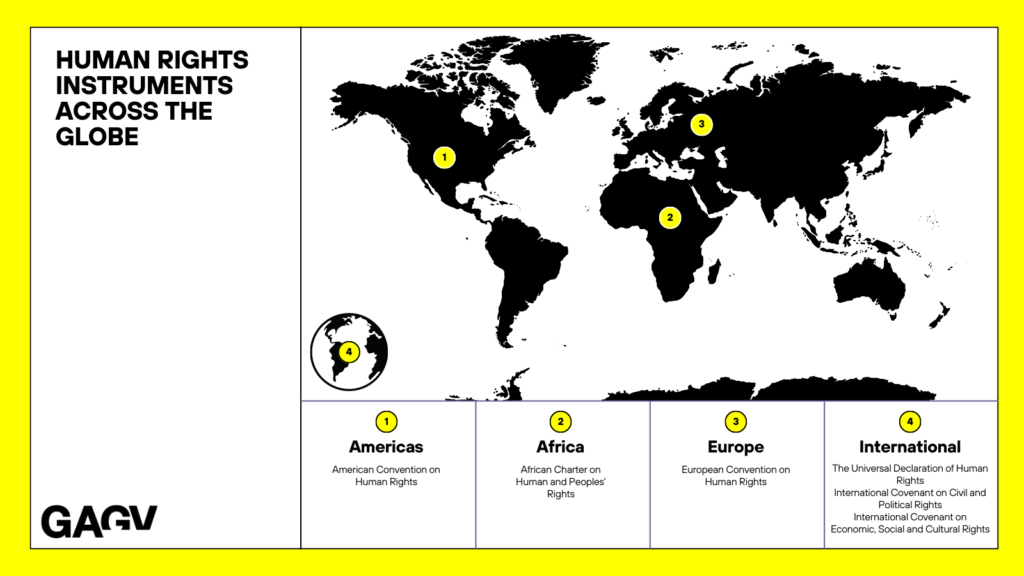
Human rights are fundamental rights to which all human beings are entitled. First and foremost is the right to live. As global citizens, we are bound by a shared responsibility to uphold and protect human rights. Countries are obligated to protect against human rights abuses, and businesses have a responsibility to respect human rights as laid out in various international instruments including The Universal Declaration of Human Rights, International Covenant on Civil and Political Rights, International Covenant on Economic, Social and Cultural Rights, American Convention on Human Rights, the European Convention on Human Rights, and the African Charter on Human and Peoples’ Rights.
Gun violence threatens and infringes on these fundamental rights. The irresponsible practices and profit-driven motives of the gun industry contribute substantially to the illicit trade and misuse of firearms, causing devastating effects. The United States, like other countries, has a responsibility to prevent these human rights abuses.
International Court Opinions
On March 5, 2026, the Inter-American Court of Human Rights released Advisory Opinion OC-30/25 (in Spanish), a landmark ruling on the responsibility countries and companies have to prevent gun trafficking under international law, in response to a formal request submitted by Mexico in November 2022.
In November 2022, Mexico formally requested that the Inter-American Court of Human Rights issue an advisory opinion on a fundamental question: what responsibility do states and private firearms companies bear under international human rights law for gun violence enabled by the firearms trade?
GAGV submitted a brief in support of that request, George Washington University Law Professor Arturo Carrillo testified on behalf of GAGV at the Court’s hearing in Costa Rica, and GAGV testified before the Inter-American Commission on Human Rights in Washington, presenting evidence of how U.S. gun industry practices violate international human rights norms. We argued that the most fundamental of all human rights, the right to life, demands that states regulate the firearms industry with the seriousness that obligation requires.
International Accountability for Protecting Human Rights
While discussing the impact of gun violence on human rights, it’s crucial to consider the international mechanisms available for accountability. The Inter-American Commission on Human Rights (IACHR) has played a pivotal role in holding states accountable for human rights violations. Notably, individuals in the United States who have been directly impacted by gun violence can petition the IACHR.
One remarkable instance was the petition of Lenahan et al. v. United States, Case 12.626, Inter-Am. Comm’n H.R., Report No. 80/11 (2011), which was an individual petition against the United States. The IACHR recommended legislative change among other actions in response to this petition. This case signifies the potential influence of an IACHR decision, not only in shaping the conversation around an issue but also impacting domestic legislation.
Furthermore, in James Terry Roach & Jay Pinkerton v. United States, Case 9647, Inter-Am. Comm’n H.R., Resolution No. 3/87 (1987), the IACHR ruled that the United States violated international human rights law by allowing the executions of two individuals who were sentenced to death for crimes committed as juveniles. This decision was later mirrored by the U.S. Supreme Court, which struck down the juvenile death penalty on similar grounds in Roper v. Simmons, 543 U.S. 551 (2005).
These examples demonstrate the importance of international human rights mechanisms in holding states accountable for protecting and upholding human rights. They also illustrate the potential for individuals and communities affected by gun violence to seek redress and effect change through international avenues.
The Connection Between Gun Violence and Human Rights
The devastating effects of gun violence permeate deeply into the fabric of human rights protections. It is not just a public safety issue but a human rights crisis.
The Role of the U.S. Gun Industry in Human Rights Violations
The U.S. gun industry, driven by profit and bolstered by weak regulations, plays a pivotal role in exacerbating global gun violence. The massive outpouring of firearms exported from the U.S. fuels violence and insecurity internationally, thereby facilitating violations of human rights.
Responsibility of States and Businesses
States bear the responsibility under international law to prevent gun violence and protect human rights. Businesses within the gun industry, especially those based in the U.S., are obligated to respect human rights, and should implement comprehensive human rights due diligence policies.
A Call to Action
Countries, especially the United States, must acknowledge and address the role their domestic policies and practices play in the violation of human rights through the facilitation of gun violence. Stronger international cooperation, robust regulations, and legal accountability are urgently needed. We must champion these fundamental human rights and work relentlessly towards a world free from the scourge of gun violence. The world can save the United States from its gun violence epidemic, and together, we can save the world. As we strive for progress, we must remember: our fight is not just against gun violence, but for the preservation and respect of universal human rights.
Learn More
GAGV has compiled extensive resources of human rights law and its relation to gun violence.