
A significant obstacle to sensible, strong gun laws in the United States is the U.S. Supreme Court’s recent interpretations of the Second Amendment which are inconsistent with the Amendment’s text and purpose, and largely prevent courts from considering the public safety purpose of gun laws. GAGV is committed to reversing this dangerous precedent and returning common sense to Second Amendment jurisprudence.
The Court’s recent gun decisions are inconsistent with the legal interpretations that were widely accepted for most of American history. For over 200 years, U.S. courts consistently interpreted the Second Amendment as limited to participating in the “well-regulated militia” for “the security of a free State” as reflected in its text and the Framers’ documented intent. In 2008, a sharply divided Supreme Court upended that settled reading in the 5-4 District of Columbia v. Heller decision, in which Justice Scalia wrote for the majority that the Second Amendment protects the right of law-abiding citizens to a handgun in the home for self-defense, with no connection to a militia required. As a result, for the first time, gun laws restricting private gun ownership and use, which historically have been established by democratically elected legislatures and policymakers, could be challenged and struck down by courts on Second Amendment grounds.
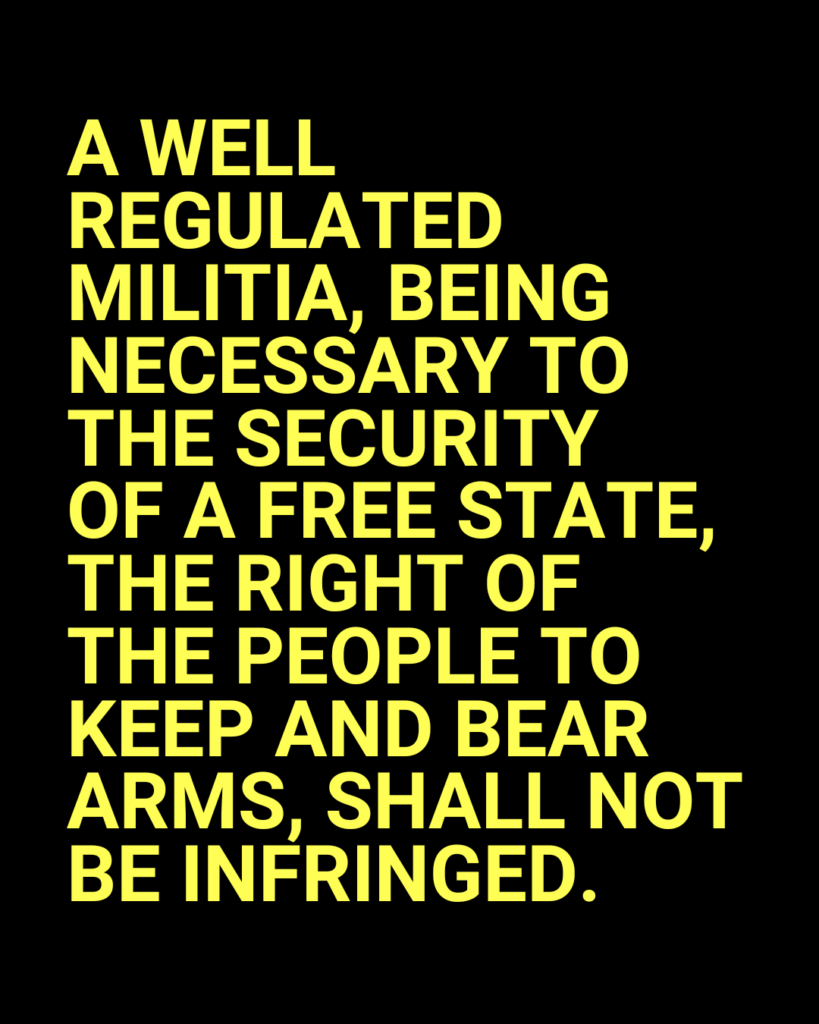

While the Court in Heller incorrectly read the Second Amendment inconsistent with its text and intended purpose, its damage was limited because lower courts used a sensible means-end scrutiny test to determine the constitutionality of gun laws that weighed the law’s impact on gun rights and the government’s interest in protecting public safety. But in 2022, the Supreme Court in NYSRPA v. Bruen required, instead, an unusual test under which laws that affect gun rights are presumptively unconstitutional unless they have some historical analogue, from either the 18th or 19th centuries. Bruen’s history and tradition test, and the Court’s inconsistent application of it, has led courts to strike down numerous gun laws, and created vast uncertainty. Most importantly, it has largely barred courts from considering the most important aspect of gun laws – their role in preventing injuries and death and in promoting public safety.
GAGV files amicus briefs, publishes articles, and promotes scholarship to return the Second Amendment to the longstanding sensible reading that allows legislatures to reasonably regulate guns to protect public safety, and does not require judges to play amateur historians. 21st century gun laws should not be determined by 19th century history.
Amicus Briefs
Wolford v. Lopez
In its amicus brief in Wolford v. Lopez, GAGV contends that while the challenged Hawaii law should be upheld under any test, the Court should overrule the extreme Bruen decision—which elevates Heller’s invented right into a super-right and imposes a test for firearms regulation that is unworkable and unclear in practice—and reinstate the test unanimously applied by the federal courts of appeals pre-Bruen, which allowed courts to balance Second Amendment rights with the government’s interest in public safety.
GAGV’s brief also makes the case that any Second Amendment rights implicated by Hawaii’s statute establishing a presumption that concealed carry is unlawful on private property open to the public, like hotels and restaurants, must be balanced against the property rights of the owners.
U.S. v. Hemani
In its amicus brief in U.S. v. Hemani, a marijuana user’s challenge to the federal ban on possession by drug abusers, GAGV argues that the Court should overrule both the Heller decision that overturned the two centuries-old militia-focused reading of the Second Amendment, and the extreme Bruen decision—which requires courts to play historian and only approve laws that are sufficiently analogous to laws in place hundreds of years ago.
GAGV asks the Court to reinstate the test unanimously applied by the federal courts of appeals pre-Bruen, which allowed courts to balance Second Amendment rights with the government’s interest in public safety.
U.S. v. Rahimi
On June 24, 2024, the Supreme Court of the United States, by an 8-1 vote, rejected a Second Amendment challenge to the federal law banning persons subject to a domestic violence restraining order from possessing firearms. In an amicus brief, GAGV argued that the law should be upheld, as did other groups.
However, GAGV was the only major gun violence prevention group to argue that the Supreme Court should also reverse its decisions in District of Columbia v. Heller and NYSRPA v. Bruen.
In the 2008 Heller decision, the Court overturned 200 years of precedent that recognized the Second Amendment’s intended meaning to protect state militias. In the 2022 Bruen decision, the Court held that gun laws required some historical analogue to be constitutional. The Court did not take up GAGV’s call to reverse Heller or Bruen.
Scholarship & Advocacy
Articles
From Second Class to Super Right: How the Second Amendment Devoured Property and Other Rights (Jonathan Lowy and Kelsey Frederick)
The Absurdity of Bruen: Why Are John Adams’s Drinking Habits Determining Today’s Gun Laws? (Jonathan Lowy and Christine Yared)
Guns, Gummies, and the Framers: How the Marijuana Gun Ban Case Shows Where the Supreme Court Got the Second Amendment Wrong (Jonathan Lowy)
Alternate Facts, Dueling Realities, and the Second Amendment: On NYSRPA v. Bruen (Jonathan Lowy)
Everything’s at Stake: Preserving Authority to Prevent Gun Violence in the Second Amendment’s Third Chapter (Jonathan Lowy co-authored)
The Second Amendment, Assault Weapons, and the Right To Live (Jonathan Lowy)
The Right Not To Be Shot: Public Safety, Private Guns, and The Constellation of Constitutional Liberties (Jonathan Lowy with Kelly Sampson)
Video Explainers
Do you know how the recent U.S. Supreme Court got the Second Amendment so wrong? (Jonathan Lowy)
How Supreme Court cases Heller and Bruen completely reinterpreted the Second Amendment (Jonathan Lowy)